Verse of the Day {KJV}

Showing posts with label technology. Show all posts

Friday, March 6, 2015

The Ease of {In}Convenience

I was going to update the reading list on the net I had begun but then discovered there is a blogger app. {There's an app for that!}

I don't really have much else to say but now it can be said easier. *smile*

My computer is up stairs, away from everyone and I don't really like to be away. When the kids are downstairs watching a movie or playing a game on the Wii then is a good time to be upstairs. But that only happens for a few days a week and just a movie length of time. Often I need more time to do things on the computer. 

An example is when I am researching for school, mine or theirs, it takes longer than a movie sometimes. Or more likely I am on the Ambleside Online forum to 'socialize' and I might need a little longer. 

With the blogger app and Tapatalk app, I can still do those things without having to go away.

But as I am sure many already know the ease and convenience of these apps makes it entirely too easy to ignore those we are with. My daughter loves the funny clean humor boards on Pinterest. {There's an app for that!} But I have noticed it is often she will zone out of the here and now. She is super quick to share what she sees or reads on that app but she fails to acknowledge when she's spoken to, fails to hear when *we* share something with *her*. 

So it is easy and convenient but it sure is an inconvenience!

Sunday, March 2, 2014

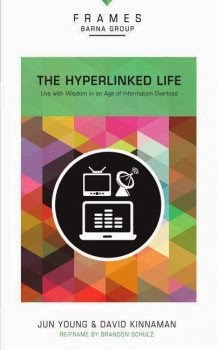
Book Review: The Hyperlinked Life {BookLook Bloggers}


This post contains affiliate links. See Disclosure/Policies.
About the book {from BookLook Bloggers}: It’s an age of accelerated information and information overload. The rate and way in which we receive information has changed dramatically: from newspapers and radio and a few nightly news programs to constant news online. We have made our lives available to the world in “tweetable” moments. As much as we try to stop consuming the vast amounts of info coming at us, we wrestle against a paranoia of ‘missing out’ on important information or being out of the loop on something. How can we rest from information, take a Sabbath for our technology or information use? How does this help us to become the right kind of factivist? The onus is more and more on us to find "the truth" and to be aware of our own biases in what we share and don't. 


More from Zondervan: In an age of accelerated content, how do you process and filter information well? What if we could read less, but know more? When it comes to being stewards of our information streams and discerning truth, we often need help in learning how to become a steward of information. Part of that is even knowing how to say “no” and “stop” to the vast amounts of info coming to us. If you feel burdened by information overload, then this softcover book is for you.

In this Barna Frame, Jun Young, an award-winning entrepreneur and communications strategist, and David Kinnaman, the President of Barna Group, wrestle through what our responsibility looks like in how we read and disseminate information.

Purchase the book from Amazon*. Paperback, 96 pages. Publisher: Zondervan. Retail: $7.99
*affiliate link

My thoughts: A short book on how technology is influencing our lives? Of course I wanted to review it! What got my attention right off is the page count is 96 pages. How can a book possibly cover enough of this topic in such a short space? 

The book starts with some questions to get the reader thinking about just how much technology- and by that I don't mean surround sound or the latest medical gadget- affects their life. 

"How many times, on average, would you say you check your phone in a given day?"
 "What is the first word that comes to your mind to describe how you feel when you leave your phone behind for any length of time?"
While I was reading I was a little smug {shame on me} for thinking, "I don't check my phone hardly ever! No one has to say 'can you put down your phone for a minute'. It's more like, 'don't you ever check your phone?'" As if the only way to have a hyperlinked life is via a phone. More common than my own hyperlinked life possibly but not the only way. Eh hee, I am guilty of doing just about everything that they suggest on my laptop if not my phone.

I mentioned that the book is short. It's written that way on purpose. It's like the way we receive our information via technology these days: in 140 characters of less {give or take a character or two}. Facebook and Twitter, not to mention the many new apps and gizmo programs that have come out that I don't even know about. The book mentioned something called WhatApp that I've no idea what is. Anyway, the book does cover a lot of ground in a short space but it's just a beginning. Neil Postman is quoted twice in the book, along with McLuhan.

When the book started, I thought for sure it would be just a small bit of what I'll call negativity followed by "let's all get wired!" mentality. But it doesn't. The negativity, imho, follows through the whole little book. That's saying something. This 'hyperlinked life' isn't going anywhere but it's necessary to understand that while it can be either good or bad, it's primarily how we let it be.
71% of adults admit they're overwhelmed by information.
54% of adults say there are times they think they actually have too much information.
35% of adults feel that their personal electronics separate them from other people {49% of Millennials feel this way!}
6% of all adults check their phones in the middle of the night. {12% of Millennials}
They do offer 'wisdom' for the digital age:
1. Get the big picture of the digital knowledge revolution.
Some of us need to be reminded that technology is not something to fear, hate, or reject. Others have to be reminded that technology should not define our lives nor be the center of them. (p. 64-66)

2. Find your own place in this revolution, your own unique relationship to technology.

One of the most direct ways to do this is to go on a digital detox...be completely unplugged from your favorite gadgets. Pay attention to your reactions and feelings. (p. 66-67)

3. Practice digital Sabbath.

This is the ancient concept- one of the Ten Commandments we often ignore- of taking one day a week to rest (see Exodus 20:8-10). Shoot for a full day a week when you turn off all your digital devices. (p. 68)

4. Develop hyperlinked habits that define the real you, and the you that you want to be.

Don't cultivate two different versions of ourselves: our online self versus our off-line self. (p. 70)

5. Mentor (and be mentored by) the next generation.

We can help them step back and realize the implications of a hyperlinked life- both the realities of what is and the potential of what should be. But we also need to be humble enough to listen to the next generation and realize staying up to date with new technology does have real advantages. (p. 72)

6. Redefine stewardship to include technology.

This suggestion is based on our belief that one of the most important aspects of hyperlinked living is to enlarge our definition of stewardship- from time, treasure, and talent to also include technology. (p. 73)

7. Be more discerning about whom and what to trust.

Ask questions! (p. 75)

Because technology as we know it is here and it will keep getting bigger. We need to be wise and considerate of how we utilize it. And this is a book published by a "Christian" company but the book can be appreciated by anyone, I think.

***Disclaimer: I received this book free from BookLook Blogger for the purpose of an honest review. No compensation was given. See Disclosure/Policies.***
I review for BookLook Bloggers

Friday, March 25, 2011

Web Design

Hello, Lee here! (I want to get one of those fancy signature thingies for the end of my posts...)

Well, a few days ago, my mom posted up a giveaway. I about freaked out over the 'Web Design for Kids (and Curious Grown-Ups)'. I really like that DVD. Although the video itself isn't the best (the speaker is kind of blah and the kids who help him are obviously reading paper scripts, you can see the tape on the computers), I really learned a lot. So when I found out she was giving it away, I had to watch it one more time and write down all the codes and such.

Like it says on the case, HTML is a good thing to learn, and it can help you later in life. It's also very simple and fun (to me, at least). The DVD doesn't cover everything; but you can always search online for codes. Which I did. : ) Anyways, I learned a few things, like adding links. What makes me sad, though, is that I can make a file that opens in an Internet browser, but it's not an actual site. To have an actual site you have to pay and stuff... *sad face*

But I can still use my knowledge of HTML on other things. Like Weebly or FreeWebs. (Maybe I'll check that out...) My knowledge can stretch out to other things, which is pretty awesome. Need help with HTML? Hey, I just might be able to help!
 
Hopefully, this turned out not as jabber-ish as I felt it was. I wanted it to have a sort of message, I guess, like my mom's do. (She's awesome, did you know?) So, anyways, if you do win the web Design DVD, yay for two reasons: you won!, and you get helpful knowledge. 

Well, bye everyone, and later...! ^.^

Tuesday, September 7, 2010

Writing versus Typing

My children have presented me with a dilemma. No, wait, it isn't my children that have presented this dilemma it is technology (and my failure to be firm in my expectations, I suppose). To type, or not to type, that is the question. Or wait, is it to write or not to write, is that the question?

With technology all around us, is handwriting so out of date? We know how to form letters, but do we really need to do it now that we can type just about everything? Will it be a problem later in the lives of my children (who aren't small anymore) to let them type everything?

"I'm more likely to write the words if I can type them" "I don't like to write them out, it makes my hand hurt" "It just takes too much time to write out, I type faster"

These are the arguments I hear when I assign 'written' work. Copywork is done still, everyday. It has been dwindled down to their Bible verses and not the lengthy work I had assigned early on. Regardless of what type of written work is assigned or expected, it either does not get done, is sloppy or I hear the arguments mentioned above before, during and after the assigned work is completed.

So my question is whether it truly matters any longer to have them write their work as opposed to typing it. I would like to see the nice handwriting that they have used before with their work. But is the aesthetic quality the only reason to still expect handwritten work? Typing can be nice and 'prettily' done but requires much less effort.

I personally do not write much more. I fill out forms at the doctors office occasionally, or perhaps I write a note to a friend sometimes. But more often than not, I use the computer to 'write'. Argh, these are just my thoughts on this all. I am convinced that it is more a lack of character building (stick-to-it-iveness) that I have failed to foster in not only my children, but myself as well. I just wonder if this 'battle' of writing versus typing is one that needs to be fought or resigned as not that important. Pick your battles, eh?
Related Posts with Thumbnails

social network stuff

PhotobucketPhotobucket Photobucket Photobucket Photobucket Page Rank
View My Stats