Verse of the Day {KJV}

Showing posts with label current affairs. Show all posts

Wednesday, April 23, 2014

Huxleyan Warning: Amusing Ourselves to Death, Chapter 11

Links in this post go to outside and unaffiliated links. I am not responsible for the content nor do I necessarily endorse the sites. My browser is set to have no ads via AdBlock for Chrome; I have no idea what you'll encounter at the sites on your browser. 


Part II, Chapter 11 The Huxleyan Warning

I have begun to read 1984 and also picked up Darkness at Noon as recommended by Postman in this last chapter to "have a fairly precise blueprint of the machinery of thought-control as it currently operates in scores of countries and on millions of people" (p. 155)". He also recommends Animal Farm, which I have already read.

It is Huxley, however that is the more correct with his prophecy: "in the age of advanced technology, spiritual devastation is more likely to come from an enemy with a smiling face than from one whose countenance exudes suspicion and hate" (p. 155). Postman directs this mostly to America, perhaps because that is where he lives and sees it taking place most, but I dare say it is world wide. Postman thought that most should have been aware of what was going on but he does point out most have been trained to see when an Orwellian world is threatening, not a Huxleyan world. We would put up quite a fight if Orwell's world were to materialize. On the opposite end, "who is prepared to take arms against a sea of amusements? To whom do we complain, and when, and in what tone of voice, when serious discourse dissolves into giggles? What is the antidote to a culture's being drained by laughter?" (p. 156)

By now we should have realized that technology is an ideology and it has the power to change cultures. 
"To be unaware that a technology comes equipped with a program for social change, to maintain that technology is neutral, to make the assumption that technology is always a friend to culture is, at this late hour, stupidity plain and simple...Introduce speed-of-light transmission of images and you make a cultural revolution. Without a vote. Without polemics. Without guerrilla resistance...All that is required to make it stick is a population that devoutly believes in the inevitability of progress...We believe nothing if not that history is moving us toward some preordained paradise and that technology is the force behind that movement." (p. 157, 158, emphasis mine)
So what can be done? There are two options as Postman sees it, and one is really not an option at all. The television {electronics} is not going anywhere; we must first realize that. That is the first option that isn't really an option. Turn off the television. No one will turn off the television {electronics} completely and for good. No one. I mean that to include even the Amish, some of who refuse modern conveniences like electricity; many have cell phones and internet, if not television. {Okay, fine perhaps there are people who have gone completely off-grid...}

Back in 1984 there were attempts at having "TV Turnoff" events. There are likely to have been similar ones more recently. {Indeed there are: Screen-Free Week (this year it is May 5-11); International TV-Turnoff Week (2006, I think)} I found the The New York Times article Postman quotes from: THE REGION; Town Is Planning 2d 'TV Turnoff'. It is interesting to note that the librarian who proposed the activity is not quoted by Postman. What she said was, "We're not really hoping for a media event this time, although that helped in some ways the last time. We're aiming at educating parents to realize why they should turn it off or cut down or be selective in what they and their children watch." The irony is evident much more by Postman's quote of Ms. Ellen Babcock. I got a chuckle out of the last sentence in the paragraph because here I am discussing this book against not just television but all that has come after it on the very media that it is against-
"It is an irony I have confronted many times in being told that I must appear on television to promote a book that warns people against television. Such are the contradictions of a television-based culture." (p. 159)
Really turning off the television {giving up the electronics} is not a viable option because people will not do it. Not even I. We don't have television in the sense that we can watch it, except with DVDs. My phone I don't think has internet capability. I've never tried nor looked to see if it does. It doesn't even have a camera, and I cannot receive images or photos. But even so, I won't give up my electronics. So this isn't really an option.

Postman is also quite pessimistic about changing the quality of television programs as an option. Instead he says that we have to change how we watch because we will watch. There are some questions that need to be asked about this thing called television.
"We have apparently advanced to the point where we have grasped the idea that a change in the forms, volume, speed and context of information means something, but we have not got any further...Does television, for example, give a new meaning to "piety," to "patriotism," to "privacy"? Does television give new meaning to "judgment" or to "understanding"? (p. 160)
And there are many more questions to ask {he lists at least a dozen other than the ones I quoted} before we can really see the television for what it is. "To ask is to break the spell," he says. The only part that Postman misses the mark is like I mentioned in last chapter's post: he failed to predict the impact of the computer. It has taken up where television left off and, even more so, is plunging us into a Huxleyan world.

Ultimately, education is the only possible solution to this problem. But his "hope" is not going to be realized by the public schools. It might be through private schools {but only a few I would dare say} or homeschools because as he says, 
"it is an acknowledged task of the schools to assist the young in learning how to interpret the symbols of their culture. That this task should now require that they learn how to distance themselves from their forms of information is not so bizarre an enterprise that we cannot hope for its inclusion in the curriculum; even hope that it will be placed at the center of education." (p. 163, emphasis mine)
It can't happen in the schools because the drive to keep and get more of the gizmos and technology that makes it super easy to have so much information is in those schools. Schools are not helping students learn to distance themselves. They cannot. What a major upheaval it would be to take away all of the electronic junk that feeds in "information" to the schools! They don't know that they are not thinking. They have all the information at their fingertips and don't realize that without them they would have to think.

And that is how the book ends. The only hope is to make people question technology and actually think about it. I say technology where Postman said television because as he himself stated "technology comes equipped with a program for social change," it isn't neutral by any means and it isn't always 'friendly'. And technology is many different things. Today it is television AND electronic gizmos, internet, i-things, smartphones, and etc. 

Monday, April 21, 2014

Common Core- Making Everyone ... Common?

I have followed only superficially the topic of Common Core (CC) because foolishly I felt that it only pertained to public schools and to those going through the elementary grades. I know, I know. Ridiculous

Today I went to Pearls Homeschool Support Group -and I am going to say right now that I wish that it was at least twice a month and not just once- to listen to Sarah Fowler, District 7 Ohio State Board of Education representative {not my district apparently} talk about CC. I'm going to request her presentation to share because I thought it well put together. 

In the meantime here are a few suggested articles and links she gave:


And although she didn't specifically recommend this link, I saw it when browsing at Pioneer Institute: What Reporters Think They Know about Common Core  I'm recommending it here because this is important to what is being 'fed' to people. Television and newspapers are big when it comes to 'knowing' what's going on. If we listen to just the reporters, we're going to be missing a lot of the picture. And boy will we be in for a surprise when we see what it is really. 

Common Core is not truly about being a more rigorous curriculum nor about making students think harder. It is about molding them into a particular kind of person. One thing Ms. Fowler pointed out was the benchmarks for CC are supposed to be internationally aligned when in fact they are up to 3 years behind the best. Ah, and I must add this in, because while I do not enjoy proofs in geometry they are fundamental: apparently the core aligned geometry is without proofs. How does that work? 

Another red flag that should have been evident at the start is that there are no research references in CC. Where there would be a footnote with a relevant study pertaining to a practice to be implemented, there is none. Or if I've misunderstood that it at least is not presented in the correct and current format that are expected. 

Right now the state of Ohio has said that they are only implementing CC for math and English but CC is in the process of writing new curricula for social studies. What's to stop them from messing with science and history?

And let's not get started on the database that they (CC) want to implement with 435 different identifiable "points"...

Common Core affects public schools -students, teachers, parents, employers- but it also affects private schools. Ohio, if I understood correctly, is one of the only states {or is it the only?} that goes through the Department of Education to issue high school diplomas to private secular schools. That means that whatever standards are adopted for assessments {end of year testing, necessary to graduate} are going to be required in those schools. In order to align to the assessments, the curriculum will have to change. Colleges are going to be using these assessments to admit students. The SAT was changed and I believe the ACT is or will be. And while I was naive about the effect on homeschoolers, it is evident to me now that those assessments will be paramount to homeschoolers being admitted to colleges. Many homeschoolers do not adhere to public school curriculum; one of the beauties of homeschooling. At what point will the government decide that homeschoolers must align their curriculum as well?

{This part I'm paraphrasing big time and totally going off of memory- she said that she'd found three distinct points that it violated and unfortunately, I can't really recall the specifics.Ms. Fowler also mentioned that really CC is in violation of the constitution which states that the states are free to choose their own curriculum, and the local school districts are free to choose. Apparently there are many who do not know this, or are afraid to go against what is in place. As she said, what teacher knowing their very job is tied to assessments will not use a prepackaged curriculum to fit with those assessments? Another thing is that under the wording of CC, while the school districts may 'change' the curriculum, it specifically states that it means the school may only add to the curriculum, and only in the proportion of 15%. That means that the schools are 85% controlled by the federal government. That is completely against the constitution!

I think I should end here because I do not know more about CC than what I learned today. I have seen the many math sheets floating around facebook, and while I find them to be frustratingly complicated, I cannot say that they are evil. I have also seen the approved reading lists for all grades and while there are many titles that I would not read myself because of the content, I can't say that the whole program should be tossed because of that. No, it is much more than those things. There is something wrong when a big business pays the government to implement a program that is not only faulty, not backed by any research, but not even legal in our country. 

There are many who feel CC will brainwash the students. If by that they mean it will shove everyone into a mold where everyone is the same, I agree. Much of CC, from my understanding is not concerned with the right answers but how much effort is put in. But if that is how we are to be 'graded', on a curve, compared to everyone else's effort, isn't it just trying to make everyone equal and common? There would be no extraordinary

Here is one last link that I just came across {via Pioneer Institute I believe}: Common Core Razes Charter School Standards

Teaching as an Amusing Activity: Amusing Ourselves to Death, Chapter 10


Part II, Chapter 10, Teaching as an Amusing Activity

While Postman does indeed have the right idea in this chapter, I think he really missed out on how much of an impact the computer would eventually have. Either way, the fact that television, and now computers and like technology, isn't really intended to help education but rather education is to help entertainment is evident. 

Postman begins with "Sesame Street". It was a bad idea from the start. It wasn't really to help educate children; it was to help children love television more. Because using television -and I think I will switch this here to stay modern technology because television itself is, imho, just about done for; it isn't what it was in Postman's time, that's for sure! -in the guise of education is a lie. It goes against traditional learning. Oh, and sure there are those who say that traditional learning is wrong and that there are better ways. Baloney. Anyway modern technology goes against book-learning and the traditional classroom. 
We face the rapid dissolution of the assumptions of an education organized around the slow-moving printed word, and the equally rapid emergence of a new education based on the speed-of-light electronic image...I mean only to say that, like the alphabet or the printing press, television has by its power to control the time, attention and cognitive habits of our youth gained the power to control their education. p. 145
There are three commandments for television:
Thou shalt have no prerequisites- this one is interesting; a show should not have to explain what it means or what went on in the last show to help understand this show. There are plenty of television shows now that do require a little backstory and even in Postman's time, with shows like "Dallas". But for the most part, each show is independent and requires no existing knowledge of what the show is about. "Television is a nongraded curriculum and excludes no viewer for any reason, at any time. In other words, in doing away with the idea of sequence and continuity in education, television undermines the idea that sequence and continuity have anything to do with thought itself" (p. 147).

Thou shalt induce no perplexity- A perplexed learner is one that will turn the channel! Thinking about this, I reflect on shows that we watch in our home. Some require mindlessness, really. Specifically I'm thinking of the television shows that our kids watch like "Teen Titans", "Pokemon" and such. They require nothing but mindless viewing. Then I think of other shows we watch such as "Jeremy Clarkson War Stories" that give plenty to chew on and think about. But unless you stop the show, you can't really take the time to digest what you've just heard and seen. There's good, and there's bad...

Thou shalt avoid exposition like the ten plagues visited upon Egypt- "Television-teaching always takes the form of story-telling, conducted through dynamic images and supported by music" (p. 148). It's hard to argue this; television and modern technology are image and sound driven.
The name we may properly give to an education without prerequisites, perplexity and exposition is entertainment. p. 148
Postman relates a project called "The Voyage of the Mimi," which consists of a television series of twenty-six shows following a whale-research laboratory. There were books printed and computer games made for the project. According to Frank Withrow of the Department of Education it was to be a "flagship of what we are doing. It is a model that others will begin to follow" (p. 150). One of the biggest flags here is that the television series is the primary focus and books are now the "visual aid". 

There are plenty of proponents for modern technology to take the place of book-learning and reading of the printed word {and just a side-note: perhaps the reason so many have a learning disability when it comes to reading is because it is a secondary feature in education now; cognitive habits have been changed with the television and modern technology as the curriculum, as Postman said in the start of this chapter} but really they cannot say with definitive truth that technology is better for learning. In fact, Postman lists a lot of researchers who have found the opposite to be true {pages 151 & 152}. "In other words, so far as many reputable studies are concerned, television viewing does not significantly increase learning, is inferior to and less likely than print to cultivate higher-order, inferential thinking" (p. 152).

Postman ends with the assertion that television is educational. 
Just as reading a book -any kind of book- promotes a particular orientation toward learning, watching a television show does the same (p. 144)...Mainly they will have learned that learning is a form of entertainment or, more precisely, that anything worth learning can take the form of entertainment, and ought to. And they will not rebel if their English teacher asks them to learn the eight parts of speech through the medium of rock music...Indeed they will expect it and thus will be well prepared to receive their politics, their religion, their news and their commerce in the same delightful way. p. 154
Continuing with my studies to be an "official" teacher {going through all the college classes} I've been so surprised and shocked that there is such a push to use modern technology in place of books in education. They say that kids "can't learn" without these; they say that it "enhances the experience"; they say that it "makes it enjoyable." What happened to learning for the sake of learning and not for the sake of entertainment? 

The last chapter of Amusing Ourselves to Death is titled "The Huxleyan Warning." That will be the last post in this series.  

Tuesday, April 1, 2014

Celebrity Politicians: Amusing Ourselves to Death, Chapter 9 {2 of 2}


Part II, Chapter 9, Reach Out and Elect Someone {2 of 2}

Continuing on with politics as show business, Postman starts by saying it might be a bit much to suggest the politician-as-celebrity on its own made politics irrelevant. But it has definitely played its part.
"Some readers may remember when voters barely knew who the candidate was an in any case were not preoccupied with his character and personal life. As a young man, I balked on November at voting for a Democrat mayoralty candidate who, it seemed to me, was both unintelligent and corrupt. "What has that to do with it?" my father protested. "All Democrat candidates are unintelligent and corrupt. Do you want the Republicans to win?" He meant to say that intelligent voters favored the party that best represented their economic interests and sociological perspective" (p. 133).
They didn't vote for the "best man," they voted their party; their loyalty. It still happens. Television does not allow viewers to determine who the best man is, rather the politician allows himself to become an image of the audience. Recall that commercials are not really about the product- there are no real claims made. It is about the viewer, in this case, the voter.

This chapter's title is taken from a play on the slogan for Bell Telephone, "Reach Out & Touch Someone." Someone is far away and we aren't likely to see them often but they are important to us, and used to hold a daily and vital role in our lives. Postman makes the comment, "though American culture stands vigorously opposed to the idea of family, there is a...nag that something essential to our lives is lost when we give it up" (p. 134). In the Bell commercials, the telephone is presented as a way to make/keep that connection; as if it were a suitable replacement. I see it as a way to make the viewer  feel better. -Sure, I moved far away and the family unit is fractured because of it but here I'll just put in a call and it'll be like I didn't leave. I'll feel better. Again, the commercial isn't about the product; they are about the viewer. The same applies to television politics.

Through the television "those who would be gods refashion themselves into images the viewers would have them to be" (p. 135). Postman brings up Abe Lincoln as an example. He is rarely photographed smiling and was prone to bouts of depression, most likely not helped by the possibility his wife was mentally unstable {Postman actually said "in all likelihood a psychopath"}. No one wants to see that! Well, actually, in today's world, perhaps people would like that; it would be entertainment {quote/unquote}. "We do not want our mirrors to be so dark and so far from amusing" (p. 136).

Postman goes on to say that "television is a speed-of-light medium, a present centered medium" (p. 136) and because of this it removes any historical content from political discourse. 

Czeslaw Milosz said our age is a "refusal to remember" (p. 137); Carl Schorske says "indifferent" because we see history as useless. Bill Moyers said, "We Americans seem to know everything about the last 24 hours but very little about the last sixty centuries or the last sixty years" (p. 137). Postman however thinks that it isn't so much we refuse to remember or find it useless, "rather, we are being rendered unfit to remember" (p. 137). He quotes Henry Ford: "History is bunk" (p. 137) Does he in fact mean the Henry Ford? Apparently:
"I don’t know whether Napoleon did or did not try to get across there and I don’t care. I don’t know much about history, and I wouldn’t give a nickel for all the history in the world. It means nothing to me. History is more or less bunk. It's tradition. We don't want tradition. We want to live in the present and the only history that is worth a tinker's damn is the history we make today."

Interview in Chicago Tribunen (25 May 1916)- source
I was rather shocked by this quote, and I realize it's going off on a tangent, but I will anyway. I've been to the Henry Ford Museum, which is huge and has a ton of, wait for  it, history. I found this little tidbit on Ford's words and thought it interesting. I guess I shouldn't be too shocked at Ford's words. Many thought the same. Many still do. 

Back to Postman: In regards Orwell's envisioned destruction of history, Postman says it's not from the state. It is more as Huxley foretold: 
"Nothing so crude as all that is required. Seemingly benign technologies devoted to providing the populace with a politics of image, instancy and therapy may disappear history just as effectively, perhaps more permanently, and without objection" (p. 138). 
It is Huxley rather than Orwell we should look to understand television's threat to liberal democracy, freedom of information. Orwell supposed that the state would blatantly control information. But this would apply primarily to books, not television. Postman goes through history sharing censorship of books because that is where "censorship had found its true metier" (p. 138).

Orwell's worries of "1) government control over 2) printed matter [posing] a severe threat for Western democracies" (p. 139) was wrong. Perhaps to the Age of Exposition he would have been right. But the Age of Television {Age of Technology} is completely different. Postman felt there was much more to fear from television glut than the government.

In the previous section Postman talked about the "Ministry Culture" by quoting George Gerbner, Dean of the Annenberg School of Communication. The jist of it: the three television networks is the Ministry of Culture, and its paid for by people who watch it or not. And it won't stop just by not watching. Someone will watch and they'll tell others. And this Postman says is the real danger: "we have no way of protecting ourselves from information disseminated by corporate America" (p. 140).

Postman doesn't think that the banning of books in high school libraries is that big of a deal. It's trivial in fact. Taking a book or a few books from a single place doesn't truly jeopardize the students' freedom to read. They could find the books elsewhere to read. But television is a more subtle threat and impairment to that freedom; it displaces books. 

Now there isn't a problem so much of a censorship; rather an overwhelming flood of information. It is Huxleyan in nature as it attempts to get us to watch continuously. Unfortunately the information is packaged as entertainment. Who would have thought that amusement would be more effective than censorship?
"How delighted would be all the kings, czars and fuhrers of the past (and commissars of the present) to know that censorship is not a neccesity when all political discourse takes the form of a jest" (p. 141).
I almost don't want to read chapter 10, Teaching as an Amusing Activity, but for me- for everyone- this is very important. Studying to be a teacher myself, the push to use any and all forms of entertainment as education is outrageous. 

Saturday, March 29, 2014

Politicians: Amusing Ourselves to Death, Chapter 9 {1 of 2}


Politics. I've never really been much into politics. It would have been much more interesting and worthwhile back in the founders' days. My opinion of course, because they didn't smear each other as a means to get votes for themselves. They ran, or rather were nominated, based on their known character, which interestingly enough, was gathered from their written works. They didn't gallivant around the country schmoozing with the public. That came later. I believe they even often refrained from communicating with  very many people because it might sway their vote

Those are my pre-thoughts. 
This post contains affiliate links; I'll let you know. See Disclosure/Policies

Part II, Chapter 9, Reach Out and Elect Someone {1 of 2}
Politics is just like show business- Ronald Reagan, 1966
I'm probably as up on sports as I am on politics, and this chapter starts with sports. Politics is a spectator sport. Postman compares politicians to athletes. Athletes' reputation rise and fall based on how well they meet a set standard. He mentions David Garth (a sports journalist?) in regards improving the image of a baseball player with a .218 batting average. Not going to happen. And Martina Navratilova's performance for tennis. Performance is what it is; it can't appear to be more or less than it is. The answer to the question of who is best doesn't get answered by a poll, rather by performance. Those who watch generally know the rules and aren't fooled.

If politics is like show business, though the standard may be there, one doesn't actually need to meet it, just appear that they do. Here Postman references Joe McGinnis' book The Selling of the President {affiliate link}. If I didn't already have too many books in my to-be-read pile, I might add this one.
What makes you cast your ballot?
A Presidential candidate or a good campaign?

How he stands on the issues or how he stands up to the camera?
The Selling of the President is the enduring story of the 1968 campaign that wrote the script for modern Presidential politicking—and how that script came to be...In his introduction, Joe McGinniss discusses why—unfortunately—his classic book is as pertinent today to understanding our political culture as it was the year it was published. -from Amazon
And just how do politicians sell themselves? Through commercials of course! "In America, the fundamental metaphor for political discourse is the television commercial. (p. 126)" Postman says that by age 40 most Americans will have viewed over one million commercials. I'd venture to say that number is larger now than in Postman's day. According to A. C. Neilsen, the average child will see 20,000 commercials in a year. They also say that by age 65, 2 billion commercials will have been viewed. I don't know how old that information is, however.

Commercials influence- period. Postman's purpose in this section is to show how it has degraded {he says "devastated"} discourse. He starts with commercial's impact on commerce. Capitalism was an offshoot of Enlightenment, like science and liberal democracy, he says. "Both buyer and seller are sufficiently mature, well-informed and reasonable. (p. 127)" It's a give-take relationship; they rely on each other to make it work well.

Monopolies and cartels undermine capitalism, of course. Even worse, Postman says, is the commercial. "Any claim must take the form of a proposition, for that is the universe of discourse, from which words are "true" and "false" come. (p. 127)" Recall in chapter 4 about advertising that they began to include illustrations and photographs. By the 1950s "the television commercial made linguistic discourse obsolete as the basis for product decisions. (p. 127)" It encouraged emotions to make consumer decisions. No claims are really made in a commercial- other than what the viewer projects on the commercial themselves. Commercials are not really about the character of the product any longer; it's about the character of the consumer. The shift has been from making and marketing quality products to making the consumer feel valued. 

Postman moves back to politics and talks about George Orwell's understanding that politics, although corrupt, would remain a distinct mode of discourse. "He feared the politician as deceiver, not as entertainer. (p. 129)" And yet the tv commercial has been one of the chief means for presenting politics. We get a glimpse into the "backroom", so to speak, of two Senate candidates through Postman's eyes. One, Ramsey Clark, prepared well with documents that included facts and figures, "carefully articulated position papers...and an enlightened sociological perspective." The other, Jacob Javits, "built his campaign on a series of thirty-second television commercials...to project himself as a man of experience, virtue and piety. (p. 129)" Javits retained his Senate seat, showing that he understood that having pictures is more important to voters than having words in this century. 

By now Americans have accepted commercials to be a "normal and plausible form of discourse. (p. 130)" Commercials are instant therapy since they address the psychological needs of the viewer {remember again chapter 4}. Postman goes on to suggest that the commercial offers a theory that is rather preposterous: "all problems are solvable, that they are solvable fast, and that they are solvable through the interventions of technology, techniques and chemistry." To read or hear this, one would understand it is a preposterous theory, says Postman. But the commercial disdains exposition; anything that would enable the viewers to think about refuting the claim (remember, commercials make no real claims any longer). Instead commercials use pseudoparables such as Ring Around the Collar to appeal to emotions but "are unambiguously didactic. (p. 131)" {Side note: unambiguous means not open to more than one interpretation; didactic means intended to teach.}
"The television commercial is about products only in the sense that the story of Jonah is about the anatomy of whales, which is to say, it isn't. Which is to say further, it is about how one ought to live one's life. (p. 131)"
So this leads to commercials giving viewers the impression that political problems have fast solutions through simple measures. But the point I like the most is that commercials use individuals from a variety of arenas -athletes, musicians, scientists, etc.- to push a product that has nothing to do with any of those professions. This allows politicians to be free from the "limited field of their own expertise (p. 131)," and people don't catch on. 

When did politicians begin to have 'celebrity' status? Being famous isn't the same thing as being a celebrity, Postman says, and while I'd not really thought about it before, of course he is right. He goes through the years pointing out which politician showed up in which tv show; most of them I don't know- the politician or the show! Did you know that former President Ford was on "Dynasty?" Huh. Ralph Nader {ah, that name sounds familiar} hosted "Saturday Night Live;" if that's not entertainment, what is! 

And on that note, I will stop this part of chapter 9. Next time Postman continues on with how this 'celebrity' status changed the way of politics. 

Thursday, March 6, 2014

Religion: Amusing Ourselves to Death, Chapter 8

Source
{If you don't see an image, it's not important.} Just change that out dated television to a computer screen, or better yet, a smart phone and it's applicable today. Do you agree?


Part II, Chapter 8 "Shuffle Off to Bethlehem"


At the start of this chapter, which is relaying how television has affected religion, Postman gives some descriptions of televangelists that I don't know who are. "Reverend Terry" who just looks uh, perfectly religious? Perhaps that is a good paraphrase. But her audience looks just like what you'd see in the audience at a Las Vegas performance, but they might be "more wholesome" looking. Reverend Terry's message is of prosperity, and getting closer to Jesus. She offers a "kit" that will bring them closer to Jesus and set them on the road to prosperity at the same time. 


By the way, according to Postman, Reverend Terry ended up filing bankruptcy...

The first more modern examples of this for me may be Joel Osteen or Joyce Meyers. I will be honest and tell that I don't listen to either but smidgens that I hear through friends. I get the impression they'd sell a kit that promises getting closer to Jesus and getting rich in the process.

Postman continues with a contrast but still the religious scene: Pat Robertson. The name is much more familiar to me. I grew up sometimes watching the 700 Club on television at my grandparents house. He is much more low key than Reverend Terry but still includes features you'd find on an entertainment show: skits, singers, and video segments. Postman states that the people featured in the videos, people who have been helped by the 700 Club, are twice elevated. First by bringing them closer to Jesus and second by making them a star on television. But which is the higher elevation? It is often difficult to tell.

Next up, Jimmy Swaggart; a fire-and-brimstone kind of evangelist. "But because this is television, he often moderates his message with a dollop of ecumenism...his message suggests that they [meaning the Jews in this particular instance] are rather to be pitied than despised but that, in any case, many of them are pretty nice people" (p. 116). Interestingly he doesn't go soft at all when speaking of the Devil or secular humanism: "Then they [evangelists in general] are quite uncompromising in the ferocity of their assaults, partly, one may assume, because neither the Devil nor secular humanists are included in the Nielsen Ratings. Neither are they inclined to watch" (p. 116).

I am afraid I will skip most of this chapter because it seems that it need not be gone over overly much. I know it is not just me who thinks that churches today are more entertaining than convicting. They are more concerned about numbers, whether through the Nielsen Ratings or the membership count at a physical location. Postman makes the repeated mention of televangelists offering something more than just salvation; more than closeness with Jesus. They offer, as Reverend Terry, "prosperity", or as he says later about Jerry Falwell, something physical. "You can get your share of the audience only by offering people something they want" (executive director of the National Religious Broadcasters Association, quoted p. 121). How many churches hold free events with freebies for those who attend? Too many perhaps.

Christianity demands much but when it is put on television, or put out as entertainment, then it is delivered as amusement and is not given serious consideration. I really like where Postman talks about how easy television makes idolatry. I would think it would be easy to see how this is, no pun intended. Preachers on television are often charismatic, appealing to us, but not because of what they preach. It is rather the presentation. "For God exists only in our minds, whereas [a televangelist] is there, to be seen, admired, adored...If I am not mistaken, the word for this is blasphemy" (p. 123). These become the graven images we are forbidden to idolize. Nowadays, I think that the entertainment factor in the church in general is becoming a problem. Did it start with the television?

I will end with these words from Hannah Arndt and the reply of Postman:
"This state of affairs, which indeed is equalled nowhere else in the world, can properly be called mass culture; its promotors are neither the masses nor their entertainers, but are those who try to entertain the masses with what once was an authentic object of culture..."
"There is no doubt, in other words, that religion can be made entertaining. The question is, By doing so, do we destroy it as an "authentic object of culture"?"
Perhaps I've only skimmed this chapter but is because it is better presented by Postman himself. There is much reference that I don't get because I don't and haven't really seen it, on television. I see it in real life.

Next chapter is titled, "Reach Out and Elect Someone"

Politics, anyone? 

Sunday, March 2, 2014

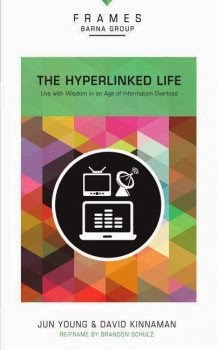
Book Review: The Hyperlinked Life {BookLook Bloggers}


This post contains affiliate links. See Disclosure/Policies.
About the book {from BookLook Bloggers}: It’s an age of accelerated information and information overload. The rate and way in which we receive information has changed dramatically: from newspapers and radio and a few nightly news programs to constant news online. We have made our lives available to the world in “tweetable” moments. As much as we try to stop consuming the vast amounts of info coming at us, we wrestle against a paranoia of ‘missing out’ on important information or being out of the loop on something. How can we rest from information, take a Sabbath for our technology or information use? How does this help us to become the right kind of factivist? The onus is more and more on us to find "the truth" and to be aware of our own biases in what we share and don't. 


More from Zondervan: In an age of accelerated content, how do you process and filter information well? What if we could read less, but know more? When it comes to being stewards of our information streams and discerning truth, we often need help in learning how to become a steward of information. Part of that is even knowing how to say “no” and “stop” to the vast amounts of info coming to us. If you feel burdened by information overload, then this softcover book is for you.

In this Barna Frame, Jun Young, an award-winning entrepreneur and communications strategist, and David Kinnaman, the President of Barna Group, wrestle through what our responsibility looks like in how we read and disseminate information.

Purchase the book from Amazon*. Paperback, 96 pages. Publisher: Zondervan. Retail: $7.99
*affiliate link

My thoughts: A short book on how technology is influencing our lives? Of course I wanted to review it! What got my attention right off is the page count is 96 pages. How can a book possibly cover enough of this topic in such a short space? 

The book starts with some questions to get the reader thinking about just how much technology- and by that I don't mean surround sound or the latest medical gadget- affects their life. 

"How many times, on average, would you say you check your phone in a given day?"
 "What is the first word that comes to your mind to describe how you feel when you leave your phone behind for any length of time?"
While I was reading I was a little smug {shame on me} for thinking, "I don't check my phone hardly ever! No one has to say 'can you put down your phone for a minute'. It's more like, 'don't you ever check your phone?'" As if the only way to have a hyperlinked life is via a phone. More common than my own hyperlinked life possibly but not the only way. Eh hee, I am guilty of doing just about everything that they suggest on my laptop if not my phone.

I mentioned that the book is short. It's written that way on purpose. It's like the way we receive our information via technology these days: in 140 characters of less {give or take a character or two}. Facebook and Twitter, not to mention the many new apps and gizmo programs that have come out that I don't even know about. The book mentioned something called WhatApp that I've no idea what is. Anyway, the book does cover a lot of ground in a short space but it's just a beginning. Neil Postman is quoted twice in the book, along with McLuhan.

When the book started, I thought for sure it would be just a small bit of what I'll call negativity followed by "let's all get wired!" mentality. But it doesn't. The negativity, imho, follows through the whole little book. That's saying something. This 'hyperlinked life' isn't going anywhere but it's necessary to understand that while it can be either good or bad, it's primarily how we let it be.
71% of adults admit they're overwhelmed by information.
54% of adults say there are times they think they actually have too much information.
35% of adults feel that their personal electronics separate them from other people {49% of Millennials feel this way!}
6% of all adults check their phones in the middle of the night. {12% of Millennials}
They do offer 'wisdom' for the digital age:
1. Get the big picture of the digital knowledge revolution.
Some of us need to be reminded that technology is not something to fear, hate, or reject. Others have to be reminded that technology should not define our lives nor be the center of them. (p. 64-66)

2. Find your own place in this revolution, your own unique relationship to technology.

One of the most direct ways to do this is to go on a digital detox...be completely unplugged from your favorite gadgets. Pay attention to your reactions and feelings. (p. 66-67)

3. Practice digital Sabbath.

This is the ancient concept- one of the Ten Commandments we often ignore- of taking one day a week to rest (see Exodus 20:8-10). Shoot for a full day a week when you turn off all your digital devices. (p. 68)

4. Develop hyperlinked habits that define the real you, and the you that you want to be.

Don't cultivate two different versions of ourselves: our online self versus our off-line self. (p. 70)

5. Mentor (and be mentored by) the next generation.

We can help them step back and realize the implications of a hyperlinked life- both the realities of what is and the potential of what should be. But we also need to be humble enough to listen to the next generation and realize staying up to date with new technology does have real advantages. (p. 72)

6. Redefine stewardship to include technology.

This suggestion is based on our belief that one of the most important aspects of hyperlinked living is to enlarge our definition of stewardship- from time, treasure, and talent to also include technology. (p. 73)

7. Be more discerning about whom and what to trust.

Ask questions! (p. 75)

Because technology as we know it is here and it will keep getting bigger. We need to be wise and considerate of how we utilize it. And this is a book published by a "Christian" company but the book can be appreciated by anyone, I think.

***Disclaimer: I received this book free from BookLook Blogger for the purpose of an honest review. No compensation was given. See Disclosure/Policies.***
I review for BookLook Bloggers

Monday, February 17, 2014

"Now...This": Amusing Ourselves to Death, Chapter 7


*A little side note: My husband asked me how I couldn't have finished this book yet. And that reminded me that I'd not finished the book yet. Well, I have been somewhat busy, I suppose. I get caught up in school with the kids because that's still my job. Oh, and there were the holidays; those always take a lot of time. And then there is the fact that I started graduate courses in January. But, I'm getting back to the book and this series of posts. There are after all only 11 chapters {only 4 after this one}. How difficult can it be?*

Part II, Chapter 7 "Now...This"

Terrible words, "now this". It means that what you just heard or saw was unimportant. The next thing will be much more important. Of course that will be followed by something to make the previous story just as unimportant as the very first. Or at least that's how Postman sees it. But it's not all televisions fault. After all, the telegraph and photograph started the fast paced, in-your-face, fragmented series of discourse. Television is just the child of the two combined. 

And here is one way we are 'amusing ourselves to death': 
"Of course, in television's presentation of the "news of the day," we may see the "Now...this" mode of discourse in its boldest and most embarrassing form. For there, we are presented not only with fragmented news but news without context, without consequences, without value, and therefore without essential seriousness; that is to say, news as pure entertainment (p. 100)."
The next couple of paragraphs talk about what it takes to make a news program that will attract the largest viewing. It takes an attractive news anchor, of course! In 1981 a woman named Christine Craft was fired because apparently studies showed that her face hindered viewing, therefore numbers dropped for the station. You can bet she filed a lawsuit.

Postman suggests that viewers believe or disbelieve a news cast based on the appearance of the person presenting. Acceptance of the news, or interpretation of importance, is based on credibility of the reporter. But credibility, when it comes to television, is not what one would expect: it isn't how much of an authority they are in the field, whether or not they were a witness of the account. No, it rests on how well they can sell it to the viewers and how they look while doing it. Pretty sad.

Why is this sad? Because it changes truth from objective to relative; if one can make it seem so and look good while doing it, then it is so. 

This isn't about aliens, I know, but I am reminded of Georgio Tsoukalos. He looks confident, and he sounds confident. That doesn't mean that he has presented the truth. But he sure has many who think it is the truth. Now, by bringing in the 'alien guy', I'm not arguing one way or the other about aliens. 

Back to this issue with reality: it is important because it goes beyond television news- it ultimately to politics and all aspects of life {buying, selling, teaching, counseling, doctoring- okay, these are my own takes but do you see how I got there?}. In politics, Postman refers to Nixon; he even looked like a liar on television, never mind the fact that he was lying. Switch that to someone who is telling the truth but looks like a liar. Is this how we want to arrive at truths, based on the credibility of looks?

Postman continues on how those in television, behind the scenes, plan the news show. There is music. Wait, what is the music for in news? Entertainment! He says this is a clear indication of "the dissolution of lines of demarcation between serious public discourse and entertainment. (p. 102)" Other entertainment factors in a news show: Short length (not even long enough to seriously convey the facts), inclusion of visuals (quickly satisfy the curiosity; not always relevant to the news story itself; not really any explanation offered), unrealistic presentation (the newscaster rarely shows emotion; no "pause or shiver" regardless of the nature of the story; viewers rarely react), and commercials (these dull the importance of the story much like "Now...this").

This statement is quite relevant:
"The damage is especially massive to youthful viewers who depend so much on television for their clues as to how to respond to the world. In watching television news, they, more than any other segment of the audience, are drawn into an epistemology based on the assumption that all reports of cruelty and death are greatly exaggerated and, in any case, not to be taken seriously or responded to sanely. (p. 105)"
It reminds me when the Boston bombings happened and a niece and nephew questioned their parents with "what's the big deal? what's the difference between this and, say, the school shootings?" {If my sister reads this and I've misrepresented what went down, be sure and let me know, okay?} I have no idea how that actually turned out but the teens' lack of understanding how to respond to these situations is evident.

Postman gives us a glimpse of the mentality of the editor of the news show "MacNeil-Lehrer Newshour" by quoting said editor:
"Keep everything brief, not to strain the attention of anyone but instead to provide constant stimulation through variety, novelty, action, and movement. [Attention is paid] to no concept, no character, and no problem for more than a few seconds at a time...bite-sized is best, that complexity must be avoided, that nuances are dispensable, that qualifications impede the simple message, that visual stimulation is a substitute for though, and that verbal precision is an anachronism. (Robert MacNeil, quoted p. 105)"
How is this the same or different for today's news shows?

The next portion deals with Americans being some of the least informed people in the Western world. He blames this on the format of our current news. Next he talks about the extensive coverage by the media of the Iran hostage crisis {this was in 1979, so before my 'time'; read more here and here}. And yet in spite of the massive inundation of information regarding the situation, the main characters and the location, he speculates that many {at the time of his writing} still do not know what language was spoken in Iran, what "Ayatollah" means, religion of Iran, or other aspects integral to the whole thing. Based on the coverage, wouldn't it be logical to think this would become basic knowledge?

I would liken this to the events of 9/11 for many people in America today. The news coverage was massive at the time and long afterwards. Yet, many people are still fuzzy about what happened, why it happened, who was behind the whole thing, and other aspects. 

Interestingly, and quite accurately I'd say, Postman says that those of the time had many 'opinions' but really they were more accurately emotions, because they were not based on actual information. And those 'opinions' were always changing. Opinions do not change so easily. The information that was being fed to the public, and still is, is through disinformation. That is, misleading or superficial information. When news is presented in the way that television allows, that is, entertainment, it no longer fulfills the information role. Entertainment has become the news of the day. We are becoming ignorant. 
"There can be no liberty for a community which lacks the means by which to detect lies. (Walter Lippman, quoted p. 108)"
Postman gives an example of a newspaper article written in regards President Reagan's misstatements and the fact that the lack of coverage of this by the news "mirrors a decline in interest by the general public. (p. 108)" To this, I direct to many of the current President's speeches and actions, as well as the coverage by mainstream media. I do give a little more credit to the public for showing an interest in detecting lies, however, I do not have great faith that they know how to detect those lies. {Generally speaking.}

We are reminded that Nixon's lies did not gather attention until they "were given a theatrical setting at the Watergate hearings. (p. 109)" With Reagan's misstatements, Postman suggests that the detection of his contradictions {that's what he refers to them as} was not easily accomplished by the people because they were not in context, they were fragmented and voila! they disappeared. How does this relate to television and "Now...this"? Television has bred the "Now...this" which fragments things, takes them out of context, blurs the importance, or essentially, makes them disappear. "In a world of discontinuities, contradiction is useless as a test of truth or merit, because contradiction does not exist. (p. 110)" And this is because television has made our world discontinuous, no longer coherent. He did also give an example of a student's paper that has contradictions; in one area it says 'this' but in another it says 'that'. It cannot be both, so which is it. The student sees it as 'this' here and 'that' there because they come "from a different universe of discourse: the "Now...this" world of television. (p. 110)"

Since Postman's book focuses on this from a "Huxleyan" perspective he shows how this is not "Orwellian" in the sense that the President does not control the news stations and newspapers. He cannot prevent the truth from being presented. What Postman says is that we are rather being amused into incoherence, willingly. MacNeil {recall the MacNeil-Lehrer Newshour} even compared television today to Huxley's soma. {Soma was a drug that was taken willingly every single day, multiple times a day to dull thinking and enhance pleasure.} A fitting comparison.

And it isn't just television. The example of USA Today is still relevant today, almost 30 years after he wrote. It is flashy, like television; it has short stories, like television. The magazine was criticized as being superficial and theatrical in its approach, of which it is glad to boast. Going right along with USA Today are People and Us magazine, which have had an effect on television. Television taught magazines that news had to be entertaining; magazines in turn taught television that entertainment had to be news. 

Postman ends the chapter with a bit on radio: it is following in line with the television and flashy news magazines. "Such programs have little content, as this word used to be defined, and are merely an archeological interest in that they give us a sense of what a dialogue among Neanderthals might have been like. (p. 112)" {Ouch.

Next chapter: "Shuffle off to Bethlehem" 

I really hope to get back to this before another four months passes...

Before I close, I'd like to link to an Afterthoughts post that talks about The Medium or the Message. Postman referenced McLuhan in chapter 1; Brandy is discussing James K. A. Smith's Desiring the Kingdom
Related Posts with Thumbnails

social network stuff

PhotobucketPhotobucket Photobucket Photobucket Photobucket Page Rank
View My Stats