Verse of the Day {KJV}

Showing posts with label CM. Show all posts

Thursday, August 18, 2016

A Sampling of Our Co-Op

I'll spare the details of how this all came about {that could well be a post for another day} but I'm sharing here how some of our lessons {hopefully} will go at the co-op starting in the Fall. These are only examples and not the specifics that will be in the line-up.

*This post contains Amazon affiliate links. See Disclosure/Policies.*

Our group will have students ranging in age from 6 to 17 {just a couple in the upper ages}. If you would like more information about the co-op you can either send an email (with "Interested in CM co-op" in the subject line) to cmeoneo@gmail.com or visit (and ask to join) the Charlotte Mason Educators of Northeast Ohio Facebook group. Email is probably the quickest way to get a reply.


We are covering the enrichments, riches, electives, or as Wendi more appropriately called them: The Uncommon Core. These include {for our specific co-op, and not in any particular order} Picture Study, Composer Study, Literature, Folksong, Poetry, Nature Study, and Handicrafts. The last two won't be included in this post; perhaps another day, another post.

These are all introductory lessons. Recently I found someone had created a lesson plan that is just about perfect for setting up a CM lesson. It is located in the AO Facebook group (you have to be a member of the group; it's titled Method of a Lesson Rubric). I will outline the basics of the rubric. This is slightly different and also based on the Six Steps of Narration found at the AO forum.
  1. Living text
    Title/chapter/pages
  2. Introduction (set up)/Review of previous lesson
    Supplies to use
    Names, places, vocabulary
  3. Reading of text
    Student reads
    Teacher reads
  4. Narration and Conversation
    Type of narration (oral, written, act out, drawn, etc.)
  5. Closing (missed points or areas to ponder)

Picture Study- Diego Valezquez “Juan de Pareja” 

~20 or so minutes- subsequent lessons may only take 15 minutes as there will not be the introduction to the painting, as it's covered for 2 weeks

Introduce the painter and the painting (info taken mostly from wikipedia):
Diego Rodríguez de Silva y Velázquez was born around June 6, 1599 in Seville, Spain. I say around then because that is the day he was baptized, which probably happened a few days or a week after he was born. He died August 6, 1660 in Madrid, Spain.
Share image of painter.

Velazquez created between 110 and 120 paintings, mostly oil on canvas, and mostly portraits. He made trips to Italy to work on paintings but spent most of his life in Spain.

Now I’ll read from I, Juan de Pareja*. This is an introduction to the painting we will be looking at today.

Here I read pp. 140-145 (about 4-6 minutes), followed by narrations.

The painting you have is titled Juan de Pareja. Velazquez completed this in 1649-50. It is an oil on canvas painting. The size of this painting is 32 in × 27.5 in. I will show the approximate size on a whiteboard/chalkboard if possible.

Study the painting closely. Look at the details and get the picture in your mind. Remember it so well that you will be able to hang this in the art gallery of your mind. You’ll have a couple minutes to look at the picture and then you can tell what you saw.
Juan de Pareja, detail
Focus on the painting; 1-2 minutes

Okay, turn over your picture. Tell what you saw in the painting. No peeking.

Narrations

Composer Study- Camille Saint-Saens, Carnival of the Animals (Intro and the March of the Lion and The Swan)

~15 minutes
Introduce the composer (info taken from Classics for Kids and wikipedia):
Camille Saint-Saëns (French: [kamij sɛ̃sɑ̃s] (IPA)) was born in Paris on October 9, 1835, and died in Paris December 16, 1921. (May ask: What country is Paris in?)

-show a picture of the composer; if we have a timeline may place his picture in the correct place-

He was an only child whose father died when he was just a baby. He lived with his mother Françoise-Clémenceand her aunt, Charlotte Masson (with two s’s!). <added for the name!> As a boy in school, Saint-Saens did very well and enjoyed French, literature, Latin and Greek, math, and other subjects. 

In music, Saint-Saëns was a child prodigy. Who can tell what a child prodigy means? <Allow for answer> At 2 ½ he could pick out tunes on the piano; at the age of 3 he composed his first piece; and by 7 he was giving public concerts as a pianist and organist. When he was 10, he made his public debut and offered to play any one of Beethoven’s 32 sonatas from memory. He had a perfect memory of anything he had ever read.

He was born in Paris, France, but when he was in his 30s he discovered he liked to travel (eventually making 179 trips to 27 countries).

Saint-Saëns had many positions associated with music, including teacher. He was writing music during what is called the Romantic era -a time when art and music was more expressive and emotional- but his style of music was traditional and conservative and for the most part followed Classical traditions. He did write operas but they were never very popular. His best-known works are concertos, an organ symphony and The Carnival of the Animals.

What can you tell of Saint-Saens? Narration

Carnival of the Animals was a fun piece, written when Saint-Saens was supposed to be working on a more serious piece. He didn’t want it to be published in his lifetime because it was not serious enough! There were a few private performances but it wasn't published for the public until 1922.

The Carnival of the Animals has 14 movements. We will listen to 2 of those today.

As you listen, pay attention to the instruments you hear. Also, is it fast or slow, loud or quiet? How does it make you feel? If this were a story, what do you imagine is happening?

I have this on CD* and will play it for the class. 

Play: Introduction et marche royale du lion (Introduction and Royal March of the Lion) (to 1:48)

What did we hear? Narration.

Notes for teacher on the piece (from wikipedia)- if needed/wanted: Strings and two pianos: the introduction begins with the pianos playing a bold tremolo, under which the strings enter with a stately theme. The pianos play a pair of scales going in opposite directions to conclude the first part of the movement. The pianos then introduce a march theme that they carry through most of the rest of the introduction. The strings provide the melody, with the pianos occasionally taking low runs of octaves which suggest the roar of a lion, or high ostinatos. The two groups of instruments switch places, with the pianos playing a higher, softer version of the melody. The movement ends with a fortissimo note from all the instruments used in this movement.

Play: Le cygne (The Swan) starts 15:57 to 19:05

What do you think of that piece? How does it make you feel? Is it different than the first we listened to? Narration.

Notes for teacher on the piece (from wikipedia)- if needed/wanted: Two pianos and cello: the lushly romantic cello solo (which evokes the swan elegantly gliding over the water) is played over rippling sixteenths in one piano and rolled chords in the other (said to represent the swan's feet, hidden from view beneath the water, propelling it along).

Literature- The Princess and the Goblin

~20 minutes
Introduce author (info from many sources):
George MacDonald was born December 10, 1824, in Huntly, Scotland. He died in Ashtead, England on September 18, 1905.  Share picture of MacDonald. 
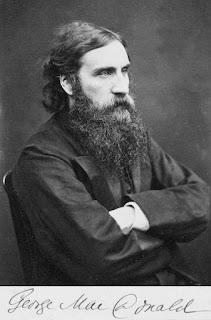
As a young boy MacDonald lived in the country and he had ample opportunity to explore the outdoors. He went to an independent school that was different from the more traditional schools, but he had poor health causing him to miss many days. When not working on his father's farm, MacDonald enjoyed reading books that fed his imagination. These helped him when he was older to write poetry and books of fantasy. Besides reading, it has been said that he spent much time riding, swimming, or just day-dreaming. At some point during his childhood, he happened upon a castle or mansion in the 'far North' in which was housed a wonderful library. This played a large role in his love of literature and helped his imagination grow even more. His experiences in the out of doors, the country side, the opportunity to explore castles, and reading books from the library helped him to write scenes that portray 'vigor and immediacy' in his own works.

Most of MacDonald's books were works of poetry or written for adults. He had eleven children and often would entertain them with his stories. This helped him see his talent for writing children's books. The story we will be reading, The Princess and the Goblin, was written in 1872.

Read chapter 1- Narrations.

Folksong- ON ILKLEY MOOR BAHT ‘AT

~10-15 minutes
What is a folksong? <allow for answers> It’s a song that folks sing! ;)

On Ilkley Moor Baht 'At is "On Ilkley Moor without a hat." It is a Traditional English folksong from Yorkshire. <Where is Yorkshire? What continent?>

This is a fun Yorkshire song (basically) about the dangers of not wearing a hat!

Listen to it all the way through first. What do you hear?
play from Youtube - https://youtu.be/qWXwqEGdWLc


"You'll catch your death of cold, we shall have to bury thee, the worms will come and eat thee up, the ducks will come and eat the worms, then we'll eat the ducks, and we'll have eaten thee.”
pass out lyrics - http://bit.ly/Folksong_Bahtat 

Want to try to sing along?

Poetry- Emily Dickinson

Our poet is Emily Dickinson. She was born December 10, 1830, in Amherst, Massachusetts, and died May 15, 1886. Share photo of Dickinson.

-read a {very} little bit from Emily Dickinson bio in Modern American Poetry anthology. 

Narrations.

I'm going to read two of her poems today. Pay attention to the words she uses and how she arranges them. As you're listening to the poem, imagine what is happening. Think of how you feel when you are hearing the poems.

Read "I Had a Guinea Golden"
Narrations
Read "I had no time to hate..."
Narrations

Monday, July 7, 2014

Our 2014/2015 School Year Folksong Selections

You can see our Youtube Playlist here 
but it doesn't include all of our choices this year.

Remember: participation, not perfection. -Lynn Bruce

We haven't ever followed the rotation at Ambleside Online for hymns, composer study, art study, or folksongs. But, really, why try to reinvent the wheel? Kwim? Actually, I wouldn't say we are following it exactly this year either; but closer than any other year!

This year we are focusing on folksongs. It won't be in place of composer or hymns; those will still be included in our days/weeks. We will be more diligent to include more folksongs. Why are we focusing on folksongs? (from Y11 note)
"From Wikipedia: The terminal state of the loss of folk music can be seen in the United States and a few similar societies, where except in isolated areas and among hobbyists, traditional folk music no longer survives. In the absence of folk music, many individuals do not sing. It is possible that non-singers feel intimidated by widespread exposure in recordings and broadcasting to the singing of skilled experts. Another possibility is that they simply cannot sing, because they did not sing when they were small children, when learning of skills takes place most naturally. Certainly it is very common for contemporary Americans to claim that they cannot sing.
There is anecdotal evidence that the loss of singing ability is continuing rapidly at the present time. As recently as the 1960s, audiences at American sporting events collectively sang the American national anthem before a game; the anthem is now generally assigned to a recording or to a soloist.
Inability to sing is apparently unusual in a traditional society, where the habit of singing folk song since early childhood gives everyone the practice needed to able to sing at least reasonably well." -emphasis mine

That and I personally cannot recall hardly any of the songs I was taught when I was younger. I think it's important to make a connection with culture- another way for the science of relations to be realized. 

Here are the folksongs we will be focusing on this year:
Term 1:
1688-1730 (Y9)
The Sky Boat Song- https://www.youtube.com/watch?v=-ATL4Nfi5-A (lyrics: http://www.contemplator.com/scotland/skyboat.html)

The Ballad of the Green Mountaineers- https://www.youtube.com/watch?v=Y4KcJTP8nW8&feature=youtu.be (lyrics on the page)

WWI (Y11)
Over There- http://www.firstworldwar.com/audio/overthere.htm (lyrics on the page)

It’s a Long Way to Tipperary- http://www.firstworldwar.com/audio/itsalongwaytotipperary.htm (lyrics on the page)

There’s a Little Blue Star in the Window -http://www.archeophone.com/sounds/2001/2001-210.mp3 (can't find the lyrics to this one)
Or Danny Boy- https://www.youtube.com/watch?v=-Jgma--0WYU 

AO Rotation
Barbara Allen- https://www.youtube.com/watch?v=EPdbHfgM0h0&list=PLhdiN-Xw0oMw1sgnD6VQxIOqlBPlUxcZv

Term 2:
1730-1786 (Y9)
The Water is Wide- https://www.youtube.com/watch?v=opfEk_Yoksk

Johnny’s Gone for a Soldier- https://www.youtube.com/watch?v=jCdo-KjiTlc lyrics on the page

WWII (Y11)
White Cliffs of Dover- https://www.youtube.com/watch?v=tuHYnzWHS7o 

AO Rotation
Billy Boy- https://www.youtube.com/watch?v=cKRJuLHU3Qo

Lord Randal- https://www.youtube.com/watch?v=MMR55HoeSG4&index=6&list=PLhdiN-Xw0oMw1sgnD6VQxIOqlBPlUxcZv 

The Keeper Did A-Hunting Go- YT- https://www.youtube.com/watch?v=racxiCMSClk&list=PLhdiN-Xw0oMw1sgnD6VQxIOqlBPlUxcZv&index=14

Term 3:
AO Rotation
Yellow Rose in Texas- YT- https://www.youtube.com/watch?v=OZRisGHL7ow&index=17&list=PLhdiN-Xw0oMw1sgnD6VQxIOqlBPlUxcZv

Pick a Bale of Cotton- YT- https://www.youtube.com/watch?v=-ILbUduwBkg

Vietnam/Civil Rights Era (Y11)
Where Have All the Flowers Gone?- https://www.youtube.com/watch?v=T1tqtvxG8O4

Okie from Muskogee- https://www.youtube.com/watch?v=n4AgZST_TG8

Tuesday, April 15, 2014

The Living Page- Nature Notebooks and Scrapbooks


Late again to the discussion but I'm sure that's alright. This time the discussion is over pages 17-25 in The Living Page*. If you came here first and haven't been to Wildflowers & Marbles, I would suggest you go there {now or later; not trying to get rid of you *smile*}. She has some printables that are useful with nature study. Lists that are simple, and pretty too.
We all have a need to be trained to see, and to have our eyes opened before we can take in the joy that is meant for us in this beautiful life. ~Charlotte Mason
This entire chapter, Gallery of Forms, is a "catalogue, incomplete to be sure, of the various notebooks that appear in Mason's writings. (p. 17)" I especially like the last sentence in the paragraph where Laurie says there is undoubtedly more to come. I very much hope so! 

And so we start with Nature Notebooks. You can see some of my personal nature notebook pages as I've put them on a page of my blog. 

I found it to be quite interesting, but really not terribly surprising, that Mason was in some way responsible for many of Sir Robert Baden-Powell's ideas for the Boy Scouts. Before Mason though was Gilbert White and his use of nature journals. He's quite famous over in England. I think I've seen them on Gutenberg and they are straightforward, much like the example Laurie gives on page 20. So nature journals needn't be extreme or complicated. This is something that perhaps people get caught up on. There are notebooks that people keep that are quite wonderfully done; illustrated beautifully. It doesn't necessarily have to have illustrations. 
The nature notebook is a dated observation of the progression of the seasons week to week, including drawings, prose, and information gathered on a need to know basis. It can include geology, geography, the course of the sun, behavior of clouds, weather signs and many other observations. (p. 21)
The Scrapbooks/Collections is "less about amassing finds than ensuring this personal connection" (p. 24, emphasis mine)" And Laurie quotes a Parents' Review article, "A Few Words About the P.N.E.U." by M. Reppman, of which I put a small portion here:
Every year, in May, during the annual conference, there is an exhibition of the works made by the young members of the club {the history clubs are talked about more in Jen's post}, which consist in collections of dried plants, drawings of flowers, plants and insects, which are often accompanied by personal descriptions, remarks and observations of the young explorer. (quoted on p. 24, emphasis mine)
Here is a page from both of my kids' nature notebooks. They are different but both perfectly acceptable. 


The next discussion is over pages 26-38, a lot more of the notebooks mentioned in Mason's writings. I'm really interested in "The Enquire Within” or Household Book. 

Friday, March 14, 2014

Year 8, Term 2, Exam Results

These are my 9th grade ds' Y8 T2 results. I'm fixing all spelling errors. I just cannot type them incorrectly; any that remain are mine Dodgy I've put the questions and the answers here. 

Bible
1. Discuss in detail two of God's attributes.
A- I don't remember specific attributes. I do remember some things that were stated. God is omnipotent, omniscient, and omnipresent. He is merciful and kind, but set against sin. God will not change. How he was and is, He will be that way forever. God wishes none should sin and suffer the consequences, but rather join him in Heaven. 

2. Recite all verses learned thus far.
A- Recited. We use SCM memory box. Just a couple were not well memorized.

3. Relate a passage from your Bible reading that has been especially profound to you, and tell why.
A- I have been reading in Job. I am amazed at how Job reacts. He is complaining, yet never blaming God for any of his suffering. Job knew that he had done nothing wrong yet said "Blessed be the Lord." Job really shows how we should be when God gives us a trial. I found it inspiring how Job knew God's laws and rules so well, that he could say without a doubt, that he had done no wrong when others told him to repent.

Writing/Penmanship {he wrote in print, executed "perfectly." This is is own original poetry.}
Write 8-10 lines of poetry in your choice of verse.
A-
The Dishwasher

Off in the kitchen, there is a loud crack.
A plate had slipped right out of his hand.
It fell to the ground, almost hitting the cat's back.
The man sighed, this wasn't going as planned.
He was of noble blood, from the house of Asher.
As he picked up the pieces from the ground,
The cat rubbed itself against the noble dishwasher.
The man smiled, the feline was his only friend still around.
The End

Composition
1. Tell one episode from Westward Ho!
A- After sinking the Rose, Amyas and crew wandered the large island for three months. Out of the original 80 of the crew, only 50 or so remained. The Indian boy they had held captive decided to join them. The crew had been sick shortly after heading inland, killing a few. As they crossed a river, Indians shot some. Later they were going through a mountain pass and more Indians attacked them. Jack Brimblecombe and some others held them off so the others could escape. They all died heroically. Amyas remained calm and collected through all of it. Amyas decided the best path would be to try the mountain path again. The crew remains faithful and would follow their captain to the end of the world. The crew no longer has any shot left, but with the help of the Indian boy, have a large collection of bows and arrows. They head towards the mountains at the end of the chapter.

2. "All the world's a stage." Explain.
A- I believe this means that inspiration comes from everywhere. It could also mean that life is a story that we can watch others "act" in. Oh, the quote is from Shakespeare.

3. Tell something of Sir Walter Raleigh.
A- Sir Walter Raleigh was an author during Queen Elizabeth's reign. He wrote a book about a boat called the Revenge. It was a recording of a real battle. The Revenge held off many Spanish ships until there was little crew left. Only five or six lived to tell the tale. Raleigh wrote this book in memory of the men who died and as a sort of "it's the least I could do" type of thing, for Raleigh was originally called to go on the voyage with them, but had been sent back shortly before it left. Raleigh was thrown in the tower after Elizabeth died by the new king. The new prince would visit Raleigh. The two became good friends. Raleigh started to write a book for him, but as he was in the middle of writing it, the prince died in a riding accident. Raleigh was heartbroken and never finished his book.

English {we aren't doing grammar this year- working through POWA}
A- Worked in POWA.

History
2. Give an account of The Mayflower.
A- When Queen Elizabeth was in power, Puritans were very persecuted. A group of Puritans, wishing for peace, fled to Holland.They were there for 10 years before they decided they wanted to go to the new colonies in America. They talked with the Virginia Company, who was going to help them get over there. But first, they had to have the king's permission. The king, James I (for Queen Elizabeth had died whilst the Puritans were in Holland), asked them what they would do for a living. They told him fishing, and he granted them allowance to go. 101 people got onto a boat called the Mayflower. It took 2 1/2 months to get across but they did. They survived a tough first winter. That's all I remember.

4. Describe the New Model Army and trace the growth of Cromwell's power.
A- Cromwell's new model army was really simple. Back then, each general had their division. They all did what they thought was best. It caused confusion. Cromwell made it so there was a base attack plan for the entire army. This division did one thing every battle. And it worked quite well.

6. Tell about Johannes Kepler.
A- Mr. Kepler was smart and into astronomy. He often short sold himself. One example is when he was offered a position as an astronomy teacher. he worried that he couldn't do it. His friends rolled their eyes and told him to take the job. Kepler did and he enjoyed it immensely. 

Geography
1. Explain the theory Heyerdahl set out to prove. 
A- Heyerdahl lived in a group of islands that worshiped a god named Tiki. The natives believed that Tiki had come from far away by boat. Heyerdahl had found out that in South America, Tiki was worshiped there as well. Tiki had a different name, though. Heyerdahl knew about rafts that South Americans used out of balsa logs. Those rafts had been in use for as long as they had recorded history. Heyerdahl's theory was that Tiki was a South American who sailed to the islands on a balsa raft. 

2. Contrast Quito with the jungle of Quevedo. 
A-I don't recall where or what Quito is/was. So I will just explain the jungles of Quevedo. It is a jungle in South America. It is where Balsa trees grow. The jungle was hot and infested with bugs. Once, the author woke up and was going to put his shoe on, when a scorpion crawled out. 

3. "Not a day passed but we . . . were visited by inquisitive guests which wriggled and waggled about us . . ." What were some of these creatures?
A- If I recall correctly, this would be talking about the flying fish. "Not a day passed but we...were visited by inquisitive guests which wriggled and waggled about us." The "wriggled and waggled about us" is talking about how the fish would jump onto their raft and flop around until they died. One of the daily tasks of the chosen cook, would be to gather the fish on the deck up and make food out of them. The fish were silvery and shiny. They had large, long fins. Flying fish are not very large. 

Natural History and Chemistry
1. Write, in the style of Susan Fenimore Cooper about trees in your area.
A- The Red Maple. A red maple grows behind our house. It looks about 40 feet tall. These trees, Acer rubrum, can grow up to 89 feet. It can be used for maple syrup and lumber. The leaves are gone now, but they are in a W shape when grown. In spring it has fruit called Samara. We often call them "helicopters" due to the fact that they spin as they fall. 

2. Write an entry in your Nature Journal.
completed

3. What are some elements that you have learned and their abbreviations? Tell what else you know about the elements or the Periodic Table.
A- Over the term we have learned about many elements. First I will talk about Hydrogen. It is the lightest and first element on the periodic table. Its abbreviation is H. It has 1 proton. Hydrogen is an odorless, clear gas. Next I will talk about Silver. On the table it's abbreviated Ag. It is a metal, much like another element Gold, Au. It is known for its shine and softness. More metal elements are: Copper, Cu, Platinum, Pt and Iron, Fe. On the far right of the table are the 'noble gases'. These elements are nonreactive gases, meaning they don't combine easily with other elements into compounds. Some of the noble gases are Krypton, Kr, Argon, Ar and Neon, Ne.

4. Tell what you know about Sir Humphry Davy, Dmitri Mendeleev, or Ernest Rutherford.
A- Dmitri Mendeleev (De-mi-tree Men-de-lay-ev) {this was for *my* benefit because I cannot seem to pronounce the last name correctly lol} was born in Russia. He had many other siblings. His dad died whilst he was still young. After his siblings left home, Mendeleev's mother took him to a college. they denied allowing Mendeleev to study there. The two tried another college, and this time he was accepted. Whilst Mendeleev took a large pile of blank notecards and wrote down an element on each. He also wrote the atomic weight on each as well. He arranged them by weight and left gaps for elements that hadn't been discovered. He had created the first periodic table. using this he predicted the missing elements' weights and properties. He was spot on with all of them. 

5. Why does science matter?
A- Why I think science matters, is that it helps you understand how things work. Most humans desire to know things, especially how or why this does that. It also, for Christians, helps us to understand even more how great God is.

Citizenship/Government 
1. What is the difference between democracy and liberty?
A- Democracy is very different than liberty. Liberty is not being watched over by the government. Democracy is being "taken care of" by government. The founding fathers of the US did not want democracy. They wanted liberty-free of government, except for law enforcement. The government was not to add laws or tax people. They were simply to protect. 

2. Explain how the institution of slavery works in Utopia.
A-Slavery in Utopia was quite different than how normal slavery was. Slaves, first of all, were people who owed someone or broke certain laws. One way to become a slave was to travel twice without a permit. Slaves were given gold and jewelry as a sign of being a slave. Normal Utopians did not wear gold and jewels. Slaves were treated like a human, not some inferior life form. They could work out of slavery by meeting requirements. The requirements changed for each slave, as not all slaves had become slaves for the same reason.

3. Talk about "The Ways of Love".
A- One of the ways to love is pity. It is feeling sorry for someone. Another way to love is benevolence. This is forgiving and being kind to those who did something wrong to you.

Arithmetic
Do math for the day. {He did Khan Academy.}

Foreign Language
1. Have a conversation in ASL with Colleen and Mom. 
We did but... it was very short... need to work more on ASL.

2. Describe a picture from your German reader book, in German.
A- Die Katze un der Junge. 
Der Junge ist zeigt die Katze auf ein Zauberstab. Der Junge sagt "Hund ist Katze." Der Junge setzt sich auf der Stuhl. Die Katze setzt sich auf der Tisch.

Art/Picture study
1. Describe a picture from this term's picture study.
A- The Voyage of Life: Childhood
The picture was painted by Thomas Cole, one of the Hudson River school founders. It is the first in a series of paintings. This painting is set on a river. Behind the river are large cliffs. At the bottom of the cliffs are plains. As you get closer to the river you can see some purple wild flowers. On the river is a boat of wood. On the front of the small boat is an angel figure head. In the boat are an angel and an infant. The rivers comes out of a cave.

2. Submit any artwork completed this term.

Recitation
Gettysburg Address

Music Appreciation
1. Tell about your favorite piece of music from this term.
A- Prelude to the Afternoon of a Faun
This is a piece by Debussy. It is quiet and pleasant to begin with. As it goes on it gets more exciting. You can hear a wind instrument very well. The the strings come in. It jumps in volume here and there. 

2. Tell about your favorite composer from this term.
A- Debussy was my favorite composer from this term. I liked how his music was different from the other music of his time. His music was upbeat and energetic. He wrote piano pieces and a few ballets. We listened to his Prelude to the Afternoon of a Faun.

Year 10, Term 2, Exam Results

I decided to go ahead and post the exam results for Term 2. I was overly concerned that they would be 'shabbily' done and I'd be embarrassed. I seem to have forgotten that this isn't about *me* necessarily. It is about what they have learned and retained. They did just fine, although I do see some areas that are in need of attention. That is, after all, the purpose of assessments.

These are my 11th grade dd's Y10 T2 results. Both questions and her responses. You can see the original AO exam questions at their website

Bible/Devotional (The Attributes of God and The Christian's Secret to a Happy Life)
1. Discuss in detail two of God's attributes.
A-One attribute is God's knowledge. An interesting point to this that I'd never thought about is that He knows all things because He has decreed them to be that way. It makes sense.

Speaking of decrees, that was another attribute. They are clearly linked with the omniscience of God. From the beginning of the world, God made decrees. All the universe follows them.

It's like planning an event. You say, "At this time there will be lunch." You know there will be lunch at a certain time because you planned it that way. Of course, we don't have the power to enforce things like God does.

2. Recite all verses learned thus far.
A- Recited. We use SCM memory box system.

3. Relate a point made in The Christian's Secret to a Happy Life that has been influential to you, and tell why.
A- There was a chapter on doubt about salvation. Many people don't get the 'feeling' that they are saved, and so feel that they have to recommit themselves again and again. First of all, we are not to base our spiritual position on emotions. Emotions are misleading, of the flesh. Second of all, picture someone who signed a contract. They don't worry and doubt and try to sign it again, because they don't 'feel' like it happened. Salvation is an act, not a feeling. The devil tries to weaken us by making us doubt our salvation. We must rest in the fact, and not the feeling, of our salvation.

This was helpful to me because I could not remember the exact time I was saved. It led me to doubt my salvation sometimes, and I felt I had to recommit myself. Reading that chapter, I learned to respond to the doubts by saying: "I AM saved." God has saved me; whether I 'feel' it all the time or not does not affect that.

Writing/Penmanship
Write 8-10 lines of poetry in your choice of verse. {She chose to write in cursive; executed 'perfectly'. This is her own poetry composition.}
A-
Why poetry? you ask.
Why beauty? I say.
Poetry is the beauty of life
In simple words.

Why poetry? you ask.
Why thoughts? I say.
Poetry is the deep thoughts
of the mind.

Why poetry? --
Poetry is life.

Composition 
1. Tell about John Keats, Charles Dickens, or Alfred Tennyson.
A- Unfortunately, I don't remember any of them well. 

'Born poor, managed to go to school, didn't finish college, considered being a lawyer or preacher, found he had no taste for it, got married, didn't have a good marriage, was a popular writer, but still struggled financially, an died in debt, loved and missed.' --This seems to be how most of the writers' lives went, and may or may not apply to the authors above.

2. Narrate an episode from Les Miserables.
A-The encounter of Jean Valjean with the Bishop of D-- (the town is written as that; I've taken to calling it Don in my head), or Monsieur Bienvenu (Bienvenu means 'welcome'), changed the former's life. Jean Valjean had run into deep poverty; desperate, he ended up stealing bread from a bakery. He got landed in jail for that, 5 years, I believe. But he tried to escape jail, and ended up more time. By the time he got our, Jean Valjean's time in jail was 20 years. He was very bitter inside. Jean Valjean had a yellow passport, which labeled him as a former convict. People, seeing this, wouldn't let him dine anywhere or lodge anywhere. Someone, however, told him of the good Bishop. Jean Valjean went to the Bishop's home, not really hoping for kindness at all. The Bishop gave him dinner and a bed for the night. However, Jean Valjean kept note of the silverware used for dinner, which were truly silver. He ended up stealing them and leaving in the early morning. The Bishop wasn't upset; he felt he had kept the silver from the poor, who needed it, and Jean Valjean needed it. Police caught Jean Valjean and brought him to the Bishop, automatically assuming he had stolen the silverware. Monsieur Bienvenu, however, said Jean Valjean had forgotten some other thing, and sent him on his way. This had such an impact on Jean Valjean. Before, he had been wicked as a matter of habit, but now he realized his wickedness. 

3. Summarize a poem you read this term by Elizabeth Barrett Browning.
A- The poem, I believe, is called "He Giveth Sleep," or something along those lines. Browning writes about how life can be wearisome, but she can always know that "He giveth his beloved, sleep." She ends each 6-line section with that line. The very last section talks about when she dies; her friends should not mourn, because "He giveth his beloved, sleep."

Editing
Complete the next assignment reading/exercise in The Copyeditor's Handbook. Give narration for reading.
A- The chapter I read was on capitalization. There were several sections. Proper names are rather simple- they are capitalized, no matter where in the sentence they are. Now, trademarked names like Jell-O, Post-It, Frisbee, and Teflon are a little different. If you are referring to the specific brand, capitalize it. These terms, however, have become very generalized, and so need not always be capitalized (e.g., 'he shook like jello'). 

Titles, subtitles, and captions- there are several different styles for capitalizing these. There's UP/lc (uppercase/lowercase) style (How to Read a Book) or sentence style (How to read a book). For prepositions and transition words (e.g., an, the, in, out, by), there are three styles. Don't capitalize prepositions (Gone with the Wind), capitalize prepositions of four letters or more (Gone With the Wind), or capitalize prepositions of five letters or more (Literature Through the Years).

History 
2. Explain "the South saw itself as the slave of a Union dominated by Northern capital."
A-Banks, factories, export, import, schools- the North had these, but the South did not. Certainly, the South had slavery, but it could not live forever on it. They were very dependent on the North's economy. The Capitol of the Union was even in the North! Really, everything for a nation's success was in the North, and so the South was subject to it.

3. Tell what you know about the Battle of Gettysburg or George B. McClellan, or Jefferson Davis.
A-I will tell about Jefferson Davis. Davis was the President of the Confederacy during the Civil War, but he wasn't an excellent choice. Certainly, he was a Southern, a slave owner, and had a military background, but the rest of his character did not match up to a typical Southern man. Davis owned only about 70 slaves, as much as he could care for. He never split families, and preferred to let the slaves deal with matters of justice. Davis was not a man made for politics. (Continuing on the note of slavery,) Davis pushed for the South to not depend so heavily on slavery, and to have factories and schools and railroads. The only reason Davis was elected President was because of his forceful character. He had one opinion, and that was his, and he wouldn't hear anything to persuade him otherwise. That I know, Davis did not even pursue the Confederate Presidency; he was nominated and elected by others. 

4. Discuss the role of Uncle Tom's Cabin in the American slavery debate.
A-Uncle Tom's Cabin fueled the North's dislike of slavery, while the South felt that it was an attack by Northern abolitionists. Many Northerners were shocked by the scenes described in the book; some thought they were exaggerated. Stowe later published a Key to the book, showing the real side of the book. It did prick the South in their moral sides, but they felt Stowe was accusing them of all being evil. Stowe blamed the institution, which hurt both slave and master.

Geography
1. Describe Damascus.
A-I don't remember it well, it blurs with all the other middle-east places that the author of Eothen visited. The inhabitants were likely Islamic, likely eager to please anyone British because the British were the higher power, and likely had camels that the author borrowed. More definite details escape me. 

2. Describe the "great American desert," the prairie.
A-I can describe from reading and from experience. It is not your 'typical' desert, in that it's not just sand dunes and mirages. A desert is classified by how much rain a place gets yearly (by this classification, Antarctica is a desert). I would say, by that definition, the prairie isn't really a desert. There are thunderstorms almost daily during the summer, giving plenty of rain. But how much that amounts to over a year, I don't know. Anyways, the prairie is a large, featureless expanse. There are hills, gently rolling, and the occasional rivers, but for the most part you see tall, brown grass. You may see antelope, maybe buffalo (more so in the olden days). Like a typical desert, it's hot during the day, cold at night (the evening rain makes it especially cool).

3. Detail some "scenes from Fort Laramie," or at the camp.
A-From what I remember, Fort Laramie was made of mud bricks. It [was] two sections, sort of an outer 'box' and an inner 'box'. The innermost 'box' was designed as a final retreat in case of emergency. The gate to it had only a small opening, for passing items through. 

Many of the inhabitants were Indians, or Frenchmen. From the author's view, the Indians spent all day in idleness, just lounging around. 

'Feasts' at Fort Laramie consisted of dried buffalo meat and bread (the bread is what made it a 'feast').

At one point, Fort Laramie was visited by traders and Indians. They didn't get along very well; the Indians started demanding things of the traders, and violence threatened to break out. I think of the groups left before it did get violent.

Natural History and Chemistry
1. Write an entry in your Nature Journal.
completed

2. Describe a scene from "A Hundred Miles of Warblers" or "Mountain Meadows".
A-[she missed this one; will do later]

3. What are some elements you have learned and their abbreviations? Tell what else you know about the elements or the Periodic Table.
A-I don't remember abbreviations very well. Here's some I do: Hydrogen (H), Oxygen (O), Chlorine (Cl), Potassium (K), Iron (Fe), Gold (Au), and Silver (Ag). Elements are abbreviated for ease of use in formulae, such as the well-known H20. In the Periodic Table, elements are arranged by number of protons. The number of protons determines what element an atom is. Hydrogen is 1, then Helium (He) is 2, all the way to element 118 (which is a man-made element that I don't know the name of). At the far-right side of the Table are the Noble Gases, which are elements like Neon (Ne?), Xenon, and Argon, that don't like to mix with other elements.

4. Tell what you know about Sir Humphry Davy, Dmitri Mendeleev, or Ernest Rutherford.
A-Dmitri Mendeleev is often credited as the discoverer/maker of the modern Periodic Table. Of course, in realms like science, it's rarely (if ever) the work of a single person that leads to such discoveries. Anywho, Mendeleev built on the world of another man who had tried to organize the elements into a Table. The other man (I forget his name) had recognized groups of elements that were similar, such as the noble gases. He had tried to organize the whole Table that way, by an element's properties. Mendeleev got the key to the Table's organization a little more correct. He organized by weight. Mendeleev's Table even included gaps, for elements not yet discovered. His Table was so accurate (not perfect, though), he could predict the weight and properties of any missing element. 

5. Why does science matter?
A-Science matters because of the age we live in, which is largely centered on science. Technology is constantly moving forward. What makes technology possible? Science. Well, actually, science makes everything possible.* And, so, if we want to understand, perhaps, how the batteries in our cameras work, how the tallest buildings don't fall over, or how the newest supercar gets its power, an understanding of science can help us.
*A note: Perhaps I should clarify this. Science is the study of what makes things possible. Applying this knowledge is also science. Science itself, however, does not 'make the world go 'round.'

Citizenship/Government
1. What does "Temperance avoids every excess" mean?
A-It seems a rather redundant phrase. Let's follow a dictionary trail:
temperance: moderation and self-restraint
moderate: not excessive or extreme
excess: an amount or quantity beyond what is required
Using these, to be temperate is to be moderate, which is to be not excessive. So, it is a bit of a restating of 'temperance,' though this phrase does emphasize 'every excess.' What does this mean for us? Well, some people say temperance is not drinking (the dictionary lists this as a second definition), but true temperance is to be moderate in all things. Food, speech, sleep, all of these you can have excess of; this phrase says to be moderate in these things.

2. How many races are there? Why does our stance on racism matter?
A-Let's turn to our handy dictionary again, since I'd like to know the 'technical' meaning of 'race':
race: 1. a group of people distinguished by genetically transmitted physical characteristics.
2. a group of people united by a common history, nationality, or tradition.
3. a genealogical line; lineage.

Well, there are two different views on this. Evolutionists will claim that there are totally separate races, ones that evolved in Africa, some in Asia, etc. And by evolution standards, one race may have evolved to be better than another race, thus giving us a 'legitimate' reason for racism and assumed white superiority.

Now, on the other hand, Creationists know that we are all descended from Adam and Eve, and from Noah. After Babel, people split into language families and spread across the Earth. Over time, certain traits formed strongly in different groups. I think of it similar to cats; all breeds of cats are still cats, but some cats in Turkey tend to be white and orange and water-loving, while cats from the streets of America tend to be brown tabbies. We are all the same race, because we all come from the same source, and no one of us is better than the other.

3. Choose an issue from Evaluating Books and present the statist and "other side of the story."
A-The statists say that child labor laws are for the good of children. Now, the 'other side' says that, while the laws may have been necessary at one time, when working conditions were truly dangerous and harmful, nowadays the laws are a hindrance. Employers want people with experience, but kids can't get the experience they need, because they can't work. The old apprentice system has been done away with. Internships are similar, but you still have to be older. Once a person is old enough to work, they probably need to work, but finding a job with what little experience they have hard.

Arithmetic/Geometry
Do math for the day. {She did Khan Academy}

Foreign Language
1. Have a conversation with Jeffery and Mom. (Sign Language)
completed

2. Do a day's work in either Second Form or First Year Latin.
A- Completed Lesson XIV in First Year.

Art/Picture Study
Describe a picture from this term's picture study.
A- 'The Fifer,' by Eduord (?) Manet. It's a painting of a fifer boy against a plain tan-gray background. He's wearing a very fancy uniform, a black jacket with gold buttons and red pants with a black stripe down the sides of the legs. His shoes are those fancy kinds, black with white on the top. He has a fife holder strapped to his chest, and he has the fife raised to his lips, ready to play. He wears a triangular hat, which is red and black and has a golden tassel. 

Submit any artwork completed this term.

Recitation
Declaration of Independence

Music Appreciation
1. Tell about your favorite piece of music from this term.
A-I liked Claude Debussy's Prelude to the Afternoon of a Faun. It is a very quiet, calm, pleasant piece that makes me think of spring. It almost sounds at first as though the faun is waking up from a nap, and birds are flying above him. The piece is mostly with wind instruments, flutes and clarinets. After the faun wakes up, the music gets a little louder and stronger for a bit, as though he has awoken in an amazing spot, maybe by a waterfall in the middle of a forest. It definitely sounds like music for a spring or summer forest. 

2. Tell about your favorite composer from this term.
A-None of the composers particularly stood out to me this term, but the one I liked most was Sir Edward Elgar (I may have gotten his first name wrong). He composed Pomp and Circumstance, which is often played during graduations. Elgar was an English composer (or should I say British?) who came at a time when England had long gone with [out?] any composers of its own. He wasn't born 'Sir', but later was given that title by the queen because of his great music.
Related Posts with Thumbnails

social network stuff

PhotobucketPhotobucket Photobucket Photobucket Photobucket Page Rank
View My Stats